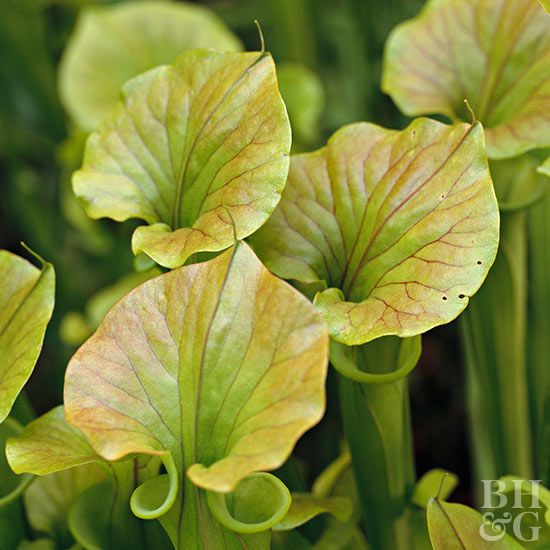
Sarracenia is a genus of North American pitcher plants comprising eight to eleven species. These carnivorous plants trap and kill insects by luring them into their trumpet-shaped pitchers. The insects tumble down into the pitcher, where they are trapped. Eventually, the insects die, and their nutrients are absorbed by the plant for nourishment through special cells.
Wetland destruction and poaching have led to a dramatic decimation of pitcher plants in their native habitats. By planting pitcher plants—only sourced from a reputable nursery and never taken from the wild—in your garden, you can help preserve these fascinating, endangered plants.
The plants grow from rhizomes and bloom for two to three weeks in the spring. They develop new pitchers, or leaves, in spring and summer.
| Genus Name | Sarracenia spp. |
| Common Name | Pitcher Plant |
| Plant Type | Perennial, Water Plant |
| Light | Part Sun, Sun |
| Height | 12 to 32 inches |
| Width | 6 to 8 inches |
| Flower Color | Green, Pink, Red, Yellow |
| Season Features | Spring Bloom |
| Special Features | Good for Containers |
| Zones | 10, 3, 4, 5, 6, 7, 8, 9 |
| Propagation | Division |
| Problem Solvers | Deer Resistant |
Choose a location in full sun with consistently moist, acidic soil, ideally a bog or rain garden. Meeting the moisture requirement of the plant can be challenging, that’s why many gardeners grow pitcher plants in containers.
Pair it with other moisture-loving plants that thrive in acidic soil.
Plant a pitcher plant in the spring so it has the entire growing season to get established. Dig a hole about twice the diameter of the nursery pot and about the same depth. Place the plant in the hole and fill in original soil to the top of the root ball. Gently tamp down the soil and water it well. Keep the soil evenly moist at all times.
Space plants 10 to 12 inches apart depending on the height of the variety.
Provided that the pitcher plant gets the consistent moisture it needs from natural sources (rainfall or boggy area), it is a low-maintenance plant.
The bog garden should be in full sun to promote full leaf coloration and strong, upright growth.
The plants grow best in a humusy muck that is constantly damp but doesn't have standing water. One of the biggest mistakes is to keep the plant too wet. Consider irrigation hoses and rubber pond liners to create the proper environment for pitcher plants.
Soil acidity is equally important. To make sure the soil has the required pH of 3.0 to 5.0, do a soil test before planting.
The hardiness varies between the species so make sure to select one that is suitable for your area. The plants do best in medium to high humidity.
To overwinter potted plants that are winter-hardy in your climate zone, bury the pot up to the rim in the garden. Choose a protected location, such as the south side of a building or in a protected corner of the landscape to shield them from freezing winds. Containers may also be brought inside in winter and kept in a cool area, such as an unheated garage or basement. When overwintering the plants indoors, keep the soil lightly moist.
The plant does not need much fertilizer, as carnivorous specimens prosper when they feed on prey. At the most, use a pelleted (slow-release), high-nitrogen fertilizer once in the spring as the new growing season starts.
In late fall, the leaves will turn brown, then the plants will die back to the ground level. Leave the dead foliage over the winter to insulate the roots from the cold and only remove it in the spring just before the flowers emerge.
Pots make it easy to enjoy pitcher plants. Rather than building a bog in your yard, a container can become a bog with a few simple steps. Fill an 8-inch plastic container—plastic is best because it will retain moisture well—with half peat and half perlite or vermiculite. Do not use potting soil and fertilizer for pitcher plants, both have the potential to kill pitcher plants. Place the container in a spot that receives at least six hours of direct sunlight each day. Set the pot in a tray filled with water. The constant moisture will keep the peat and perlite mixture wet, creating a bog-like environment.
Once the roots fill the pot, repot the pitcher plant to a larger container filled with fresh potting medium or divide it.
Sarracenia are generally resistant to serious pests and diseases. The plant attracts aphids, especially in early spring and fall. You might also find scale insects and mealybugs on the plants, especially under the trap folds. Wash them off with a strong spray of water. If you find moth larvae, remove them manually.
Leaf spots and root rot may also occur.
Pitcher plants can be propagated by dividing a mature plant. Look for a strong, healthy rhizome that is anchored into the ground with roots. Carefully dig out the rhizome without damaging its roots. Using a sharp knife or pruners, cut the rhizome into smaller sections so that each section has some roots on it. Replant the sections at the same depth as the original plant.
Planting the sections in pots is usually preferable, as it gives you better control over the soil moisture. Once they have grown into vigorous plants, they are ready to be planted in a boggy spot in the landscape.
Sarracenia flava offers one of the largest and most spectacular blooms within the Sarracenia genus. It has upright narrow leaves adapted into pitchers with round mouths and a semi-upright open flap covering them. The nodding long-petalled flowers are chartreuse and appear in spring. It grows 12 to 32 inches tall. Zone 7-9
Sarracenia oreophila is considered the most endangered species in the Sarracenia genus, known to exist only in a few mountain sites in North Carolina, Georgia, and Alabama. The pitchers resemble those of the yellow pitcher plant but with a light chocolate veining. It grows 10 to 18 inches tall. Zone 7-9
Native to the southeastern United States, Sarracenia rubra has flowers with long, strap-like maroon-dark red petals from April through June. The plant reaches a height of 12 to 24 inches. Zone 6-8
Also known as yellow trumpets, Sarracenia alata is native to thesoutheastern United States, including parts of the Gulf Coast states. Reaching 16 to 24 inches in height, it is one of the taller pitcher plants, with gold-yellow flowers in March and April. Zone 6-8
If you are looking for an especially hardy pitcher plant, consider this cultivar of the northern purple pitcher plant. It was cloned from a pitcher plant that originated in Ocean County, New Jersey. The pitchers are brilliant red with chartreuse veining and cherry-red umbrella-like flowers appear in April and May. Zone 3-8
Call on marsh marigold when you are faced with a boggy spot because this perennial loves moist soil. It is native to marshes, swamps, stream margins, and wet meadows in Newfoundland and Alaska south to Nebraska, Tennessee, and North Carolina. It can be in partial shade or full sun, however, the soil must never dry out. Zone 3-7
You might know papyrus as a plant that grows in standing water but in fact you can also plant it in wet, fertile soil, either at the edge of a water garden or someplace that stays consistently moist, Papyrus is not winter-hardy in climates with freezing temperatures but because it grows so fast, treating it as an annual and planting a new papyrus in the spring will produce a tall plant in just one season. Zone 10-11
The curious corkscrew rush (Juncus effusus ssp. spiralis) loves wet or boggy conditions. It makes a fascinating architectural accent in planters, beds, and moist borders. It's technically leafless, with green cylindrical stems that are pointed at the tip. Plant rush alongside streams and ponds, though it will tolerate dryer conditions elsewhere. It's excellent in container gardens. Zone 5-11
At home in soggy soil, pitcher plants have exacting growing requirements. The more you can mimic their native environment, the more you’ll have success with pitcher plants.
Indoor gardening and pitcher plants usually don't mix. The plants require bright sunlight during the growing season and cold dormancy in winter and indoor gardening doesn't satisfy these needs. A temperature-controlled greenhouse, on the other hand, is a good place to grow pitcher plants, as it offers sufficient light and makes it easier to maintain the required moisture level than in an indoor location.
Updated by Nadia Hassani
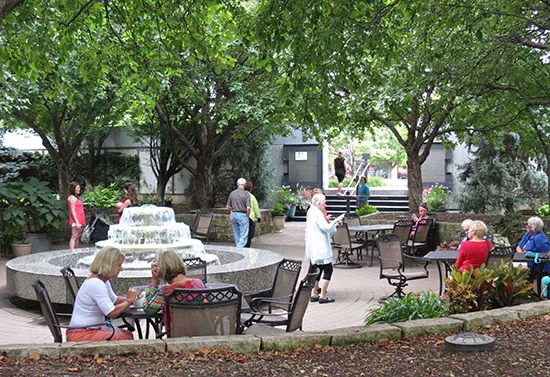
Visiting the Better Homes & Gardens Test Garden®
The BHG Test Garden is a beautiful green space that has something to see in all seasons.
Silencing the Siding Peckers: A Gardener's Guide
Silencing the Siding Peckers: A Gardener's Guide
The Allure of Annuals China Aster in Your Garden
The Allure of Annuals China Aster in Your Garden
The Secret of Endless Blooms: Long - Blooming Perennials
The Secret of Endless Blooms: Long - Blooming Perennials
The Hardy Agave: A Cold - Resistant Floral Wonder
The Hardy Agave: A Cold - Resistant Floral Wonder
How to Plant and Grow Muscadine Grapes
Learn how to plant and grow muscadine grapes and harvest delicious fruit for fresh eating, preserves, and wine.
How to Plant and Grow Lima Beans
Find essential tips for growing lima beans, also known as butter beans, to pick them fresh or dry them for later use.
Unveiling the Wonders of Gourds in Your Edible Garden
Unveiling the Wonders of Gourds in Your Edible Garden
9 Tips for Companion Planting Vegetables to Boost Harvests
Companion planting is a natural and organic gardening technique that helps repel pests and grow healthier plants. Use these smart tips to start companion planting in your vegetable garden.
How to Restring a Weed Whacker in 4 Simple Steps
Use this step-by-step guide to properly replace the line on your weed trimmer.
Secrets to a Thriving Yard Garden
Secrets to a Thriving Yard Garden
The Secret to Gorgeous Hydrangea Blooms Next Season
The Secret to Gorgeous Hydrangea Blooms Next Season
Unleash the Beauty of Your Lawn: A Guide to Perfect Mowing
Unleash the Beauty of Your Lawn: A Guide to Perfect Mowing
Guide to Soils and Potting Mixes
We know the secret to a good potters soil. We'll show you how to tell if you need to amend your soil and what plants need to thrive in your current soil conditions.
How to Use Fertilizer for Plants According to Experts
Get expert tips on fertilizing plants, including the best formulation for both houseplants and garden plants, as well as how frequently you should feed them.
How to Make a DIY Indoor Compost Bin
Make your own DIY indoor compost bin. With our tips, you'll learn how to compost and reduce your kitchen waste to help the planet.
Unveiling the Secrets of a Thriving Lawn
Unveiling the Secrets of a Thriving Lawn
15 Super Plants for Texas Landscapes
These plants are superstars in Texas gardens and landscapes. Experts recommend them for their ability to thrive in south-central climates.
Your Seasonal Lawn-Care Schedule for the Northeast
Take the guesswork out of yard work. This lawn-care calendar lets you know when to mow, aerate, fertilize, and seed your yard in the Northeast.
How to Make Compost Tea That Will Give Your Plants a Natural Boost
Learn how to make compost tea with this simple guide and recipes. Plus get tips for using compost tea to give all your plants a boost.